Wearable Deep Dive
The intersection of tech and fitness
2024-01-15
In a world of infinitely expanding information, actionable data should be the key attribute we measure our data transformations by. Otherwise, why would we collect, clean, analyze, and present the data? Different brands have different goals - some focus purely on tracking and improving users’ fitness, whereas others take a more holistic approach and include specific data that encompasses ‘health’. Such as the Oura ring, pairing with Natural Cycles to collect a temperature trend to provide an absolute value to calculate a user’s daily fertility status.
This post aims to explore the current market and key metrics that you all commonly use (thank you for your feedback). Additionally, we’ll analyze their use cases for the military, civilian athletes, and the average American. We’ll also develop an understanding of what they do well, tradeoffs they make, and what they flat out don’t get right. This is not a post to sell you on any particular brand, I am unsponsored. Rather, I’m fascinated by the intersection of tech and health and hope to deliver some of my research and what I enjoy to you. Today we’ll cover:
Overview of pros + cons to the most used devices
Human Desire
Branding
What wearables get wrong
The bare minimum to track effectively without using a wearable
What I recommend if just getting into fitness wearables
Let’s begin.
The human desire to quantify is not uncommon - rather it’s deeply ingrained in society. Arguably, it goes back to the idea of logic originated by Aristotle over 2300 years ago. But the most simple measurement is time, which we often forget when talking about wearables. But there are two perspectives we can look at them. One being the shift in societal use of watches to smart watches, the other being wearable tech. Although smart watches fall under the spectrum of wearable tech, they’re a bit of a different category - including features like notifications, emails/texting, calling, maps, music, etc. Some of the devices we look at will fall in this category, blending in wearable tech focused on health and fitness. But at their most simple form, they’re still watches. Designed to tell us the time. And hopefully still maintain a decent form factor that looks good in many environments.
But the desire to wear technology to quantify our lives is rooted in the need for understanding, comparison, and decision-making.
Quantification provides concrete, numerical information that allows for easy comparison and ranking, facilitating decision making in the absence of more detailed, contextual information. We adjust our behavior based on the metrics we’re held against. Anything measured compels us to optimize our score on that metric.
Our bank account measures our liquid worth, and we optimize for more. In competitive career paths, people quantify hours worked, and either optimize for more or less. This desire to measure everything is evident in various fields such as human rights. Where there is a need to quantify and measure impacts in a meaningful and robust way but has historically been measured qualitatively. This includes measuring data that provides a stronger indicator of actual impacts on people and underlying structural factors that can be determiners of human rights risks. The urge to measure and quantify is driven by the aim to understand the world better, interact with the surroundings, and improve life. However, similar to forgetting about telling time, we can also forget about the qualitative factors when we become so focused on metrics. With human rights, organizations can become so focused on numbers that they forget to ask the simple question “how do you feel?” With fitness wearables it’s the same problem - we often get caught up in the numbers that we forget to self assess how we actually feel, opting to outsource our daily feeling of well being to a number on a screen.
Of course outsourcing our well-being to a screen isn’t new - just ask anyone who is constantly checking their instagram for a new like or comment - or how many views their tiktok got - which will be the determining factor in how happy they are that day.
I digress.
Quantification has also advanced science and health/fitness in several ways. In the field of exercise science and health, statistics and quantification continue to play a crucial role in understanding fitness outcomes and assessing the effectiveness of physical activity interventions.
Meta-analyses for example, are used to quantitatively synthesize cardiorespiratory fitness outcomes of motivational physical activity interventions, providing valuable insights into the impact of these interventions. In the context of health sciences, quantification is integrated into programs such as healthy lifestyles and fitness science, providing students with the necessary skills for employment in health-related fields. In the broader context of science, quantification has significantly contributed to the understanding of fitness outcomes, the effectiveness of health interventions, and the advancement of scientific knowledge in various domains.
The actual history of wearables focusing on health and human performance optimization goes back to the late 1960s and early 1970s when the first portable computer was invented. In 1994, Steve Mann created the “wearable wireless webcam,” leading the first example of wearable technology designed for everyday use. Going into the 2000s, we aw an explosion in wearable technology with the introduction of fitness trackers and smartwatches. The 2010s were a tipping point for wearable technology with the dominance of wearable devices like fitness trackers and smartwatches. These devices have significantly contributed to health and human performance optimization by enabling the monitoring of various metrics such as heart rate, temperature, oxygen saturation, and stress levels. This also ties heavily to my previous article American Dynamism. The information revolution and accompanying growth in compute power allowed for hardware developments into the 2000s.
So where does that leave us now?
We have a massive amount of options spanning different focuses on performance optimization, health, and general smartwatch capabilities. I argue for a balance in use of metrics and questioning how we actually feel. Combining qualitative and quantitative metrics to generate an all-encompassing ability to identify what activities help or hurt us. And using all of this to focus on the only thing that actually matters - being healthy and improving our physical performance.
That is the lens I view all wearables from. Does it provide me metrics that I will actually use to improve one or multiple facets of my health or performance?
So what metrics do we all actually care about that are available from tools on the market today? Major metrics and features by which we can rate wearables include:
Caloric Burn
Heart Health - Resting Heart Rate, Heart Rate, and Heart Rate Variability
VO2 Max
Sleep Performance - hours slept, sleep efficiency, sleep breakdown (light, deep, REM)
Temperature
Strain Score
Recovery + Stress
Logging and comparing life events/journaling
Community aspect
Integration with existing apps (strava for example)
Step Count
Mileage - running/rucking/cycling/ tracking physical activity
Battery life
Screens
Cost - purchase price, monthly subscription requirement
Usability / Ease of Use
Build Quality
How it looks (ie can I wear it to the gym and a date the same night and not look like a nerd, looking at you apple watch)
Gamification - does it make physical activity/life more fun
Actionable Insights
Impact on alcohol use
Am I actually fitter with this item
Am I actually healthier with this item
This might look like a lot. But that’s why I’m writing this. To take everything into account, all of your feedback (and there was a lot), and my personal use of different tech. First I’m going to boil down the features and metrics into a much smaller list:
Core metrics - calories, heart health, VO2 max, sleep performance, step count, strain, recovery, stress
Battery life
Cost
Ease of Use - applies to both the actual hardware and the app
How it looks
Does it make me better
These 6 (in my opinion) are the biggest factors for a wearable and will allow us to accurately compare what’s in the current market. Note, this is not about smart watches - but fitness wearables. There’s plenty of articles reviewing different watches but rarely have I seen unbiased dives across the board.
To start we’ll look at percentages of use for those of you that 1) submitted feedback and 2) actually use a wearable. From your input and the most used products, 56% use a Garmin, 29% use a Whoop strap, 18% use an Oura ring, and 13% use an Apple Watch. Note, some of you use multiple products. This may be a comination of Garmin/Apple and Whoop/Oura. There are also a much smaller percent that use Samsung, Fitbit, or smaller companies like Coros.
As mentioned, based on your submissions the primary wearables used are Garmin, Apple, and Whoop. Each brand has its own set superfans. What I mean by this is those of you that lean towards a particular brand tend to love it, especially if you’re coming from one brand to another. Few of you are lukewarm in your opinions - users tend to develop a strong bond - and for a reason. As we talked about earlier, we are after the feedback. But for the same reason we like to associate myself with specific clothing brands we like to associate ourselves with a particular fitness brand.
But this is only logical, especially if we look back at what branding actually is. It originated as a way to physically brand cattle (and is still used along with RFID, physical tags, and tattooing the inner lip or ears). Branding then evolved as a way to hallmark the quality of goods sold, to what we have now. And when a particular company represents a set of values, a type of person (think athlete), or a way of living, we associate ourselves with that brand. Psychologically, even just the act of buying a certain product attaches us to a brand and makes us feel like we made a change. Only that is just the beginning, especially when buying a wearable.
However, that’s why we buy them. Many of us are already living that lifestyle and recognize these products will allow us to maintain or enhance in certain areas of life.
So why do you use a particular brand?
Garmin
Your feedback highly praised Garmin for its durability, battery life, GPS capabilities, and a wide range of fitness tracking features. They’re rugged, great for the military and first responders. Models like Garmin Fenix, Instinct, and Forerunner are frequently mentioned. You appreciate its capabilities for tracking runs, sleep, and workouts without the need for a subscription service. When purchasing, you bite the bullet in the beginning and never have to worry about additional subscription costs.
Additionally, Garmin provides easy syncing with Strava, a solid app with community features inside (Garmin connect), and remarkable battery life across the whole lineup of watches. I have previously used a Fenix 3, and compared to the newer Fenix 6/7 is still a great product. I generally loved it, however disliked how bulky it is. The whole lineup looks good at pretty much every event, and becomes a status item when you see people wearing one - you immediately know what that person is into when seeing them in public. Garmin was also rating the highest by your feedback as the best endurance/running watch. Primarily for it’s GPS, it is the most accurate and capable watch for longer sessions where you’re tracking.
Garmin has a similar price range as the Apple watch, with Forerunners starting around $200 and the Fenix 6/7 ranging from $549-$999. With the Fenix, which was the most common watch reported from all of your feedback, at the end of the day you’re getting an incredibly durable watch, ridiculously long battery life (14-28 when smartwatch only features, 3-7 days when using GPS).
Apple
This includes feedback for both the normal Apple watch and the Ultra. From your feedback, Apple was chosen for its integration with the Apple ecosystem, the interface, and tracking abilities, especially for heart rate and calories burned. However, battery life is a major criticism here. From personal experience I would have to charge daily with an older model. However even new ones will struggle to get 48 hours while using workout tracking.
The Apple watch is interesting because in my opinion it is the best overall product on the market today. But that’s when taking everything into consideration. The biggest problem is battery life, but when paired with some apps in the app store brings it up to par with Whoop for sleep analysis. My biggest downside is you look like a nerd wearing one (but that’s just an opinion, I still love them).
As for price, Garmin and Apple both win out in cutting subscriptions and utilizing an only up-front payment. Both can be pricey, with Apple watch running from
Apple Watch SE w/ GPS, 44mm case for $270, Series 9 for $399, or Ultra II for $799.
Whoop Strap
The Whoop band is noted for its accuracy, especially in tracking sleep and recovery. However, its subscription model and price are often seen as drawbacks.
This is the tech I’m currently using. When running I usually just carry my Iphone and track with Strava. I love the ability to detect activity, whether it be a walk/hike/ or lift when I’m not actively tracking with Strava. Some of you pair with an apple watch or garmin so you don’t need your phone for rucks/runs, which is an awesome (and pricey) combo. The upside is a lot of you in special operations either get Whoops or Oura rings for free, and can pair with the watch of your choice.
I also love the app and the teams in the app. Really cool addition for team based competition. P.S., I have an Acid Gambit team going - join us with code: COMM-FA1355.
The band is also super subtle, and the battery will usually last me 3-4 days. Charging is also great, not having to take my band off. Every other wearable here actually requires removal to charge.
The recurring subscription cost for Whoop is a significant negative for many users, making it less appealing compared to one-time purchase models. Whoop includes a free month long trial where they ship you the band and can test it out, but after that will cost $16-$20 per month depending on what length you subscribe for ($399 for 24 months or $239 for 12 months).
Oura Ring
Oura is probably the most interesting and subtle tech in the list here. It is definitely more on the “health” side of the fitness wearables. Obviously it still tracks overall activity, HR, sleep efficiency, and provides a “readiness” score. This is also the only one I haven’t used personally. Some of you mentioned it is great for everyday use but can be annoying when lifting. My main complaint with it is ring rub while lifting or doing pull-ups. From your feedback, it is an excellent “wellness” tracker but not as great of a fitness tracker. If you are slightly less hardcore, aka not looking for a Garmin, this would be perfect for you.
Additionally, I will say I like the aesthetic the most. The Horizon is extremely subtle and would love to have one at some point (I’m just won over by Whoop at the moment).
Oura ring pricing has a different strategy, where you pay anywhere from $299-$549 for the actual ring, then an additional $5.99 per month.
If we look at the stealth-horizon finish for Oura ($449) the average cost over a 24 month period would be $24.69/mo or $592 in total. Whoop on the other hand would only be $399 for 24 months or $16.62/mo. Even the most inexpensive Oura would be $18.44/mo. I compare these two because they’re the most similar in features. Regardless, still a significant amount to pay but very similar in total cost if you were to use them for 1-2 years.
What Wearables Get Wrong
Caloric Expenditure
Measure of caloric expenditure is one metric that all devices get wrong. It’s not for lack of trying, but accurately computing calorie burn from a wrist or chest strapped device is nearly impossible.
A Stanford study published in 2017 found median error rates in caloric expenditure from 27%-96% when compared to the gold standard for measuring caloric burn. This gold standard involves measuring oxygen and carbon dioxide in breath.
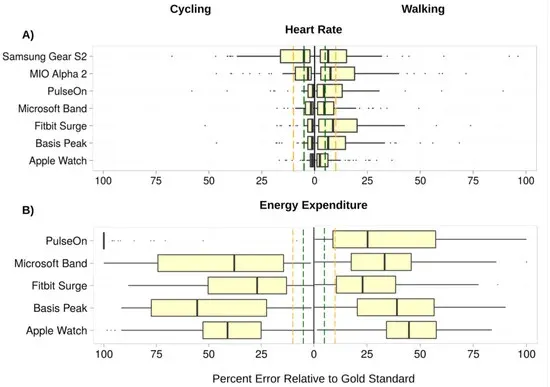
I will caveat this with the fact that it was published in 2017. 7 years is a LOT of time for advancements in accuracy. They also did not test Garmin or Whoop (due to when the study occurred). But my guess is even if they did include them, they would fall in the same error boundary. This isn’t a knock on these products - it’s a fault in the way ALL of the products measure calorie burn. They’re just estimates and don’t take into account O2 and CO2 in our breath.
As a result, caloric burn should largely be disregarded from all wearable technology and apps. There is a solution here, however. Rather than look at your daily caloric burn based on activity, look to gauge your daily burn based on trends.
This includes your activity level from your career and rigor of exercise to estimate your TDEE and daily caloric consumption to maintain, drop, or gain weight. My favorite TDEE calculator is here.
Remember this is just an estimate, however. Based on the estimated calories and macro breakdown, run it for 1-2 weeks and adjust up/down by 250 cal increments based on your goals.
The Bare Minimum
The overarching caveat to this whole article is “do you even need a fitness wearable?” The answer is a loud NO. Humans have lived for centuries without these, and only in the last decade have they started to come into our lives. Have they even made people more fit or healthy?
That’s a long term question I’m not sure has been answered yet, and it may be too early to tell.
Perhaps wearables have an effect of making those who are already in shape MORE in shape. But not affecting the bottom 75% of Americans. In other words, they’re polarizing. The say top 1% may be able to create an even bigger margin between them and the rest of athletes. A bit more awareness, feedback in their life, and conscious recovery could lead to performance improvements. But for the rest, there doesn’t appear to be any major shifts yet.
I’ve talked about this in the past, but obesity is still on the rise. Overall health issues in America seem to be getting worse, not better with the rise of consumer fitness wearables and feedback reserved for elite athletes in the late 90s and early 2000s.
But to just get by with the bare minimum, everyone already has a smartphone. I would just get some kind of run/endurance tracking app - I love Strava (and have a run club that you can join here).
The next step is to just be conscious of your daily activity and habits. That’s the most simple way to make positive changes. Hit your daily and weekly threshold for endurance work and weightlifting. Track overall mileage and hours, whether on a pen and paper or in an app. Watch your overall sleep patterns, and adjust for time in bed versus actual sleep. We already know caloric burn from the watches is a poor estimate - and reference the TDEE calculator I brought up above. That’s the bare minimum - be conscious of your actions.
I got on for a very long time without using anything but my phone. None of these are a requirement - just a fun addition to what we’re already doing right.
The decision of which wearable you get if you’re just getting one for the first time is highly personal. If you want something subtle without wrist notifications I would go Whoop or Oura. If you’re more fitness inclined, go for the Whoop. If you are more inclined to understand your general wellness go for Oura.
If you are more interested in blending a smartwatch with fitness tracking you are now in Garmin/Apple territory. Based on your feedback and having used both a Fenix and Apple watch, I’d recommend an Apple watch overall. I love the Apple UI, it’s more subtle and lightweight with a worse battery life. BUT, if you are a more serious endurance athlete, in the military, a first responder, and/or spend a lot of time outdoors, the answer here is clearly Garmin. Overall I like the apple watch more, but the Garmin can support a much more rugged lifestyle, has a better GPS, and has a significantly better battery life.
That’s it. If you have any questions/comments/concerns, feel free to drop a comment or DM me. I know this one was a bit long, so if you’ve made it this far congrats and happy Monday!
Cheers.
DISCLAIMER
This is not Legal, Medical, or Financial advice. Please consult a medical professional before starting any workout program, diet plan, or supplement protocol.